Distortion Correction Documentation
To use this plugin, users need to provide distortion coefficients which are obtained by:
Acquiring a dot-pattern image (Fig. 1a).

Figure 1. (a) Dot-pattern image is used for calculating distortion coefficients. (b) Result of applying the correction.
Using the Discorpy or Vounwarp package for calculation. Following one of examples under the folder “examples” of these repositories to know how to. Referring to this documentation to know more about algorithms used to calculate distortion coefficients from a dot-pattern image.
Importance notes:
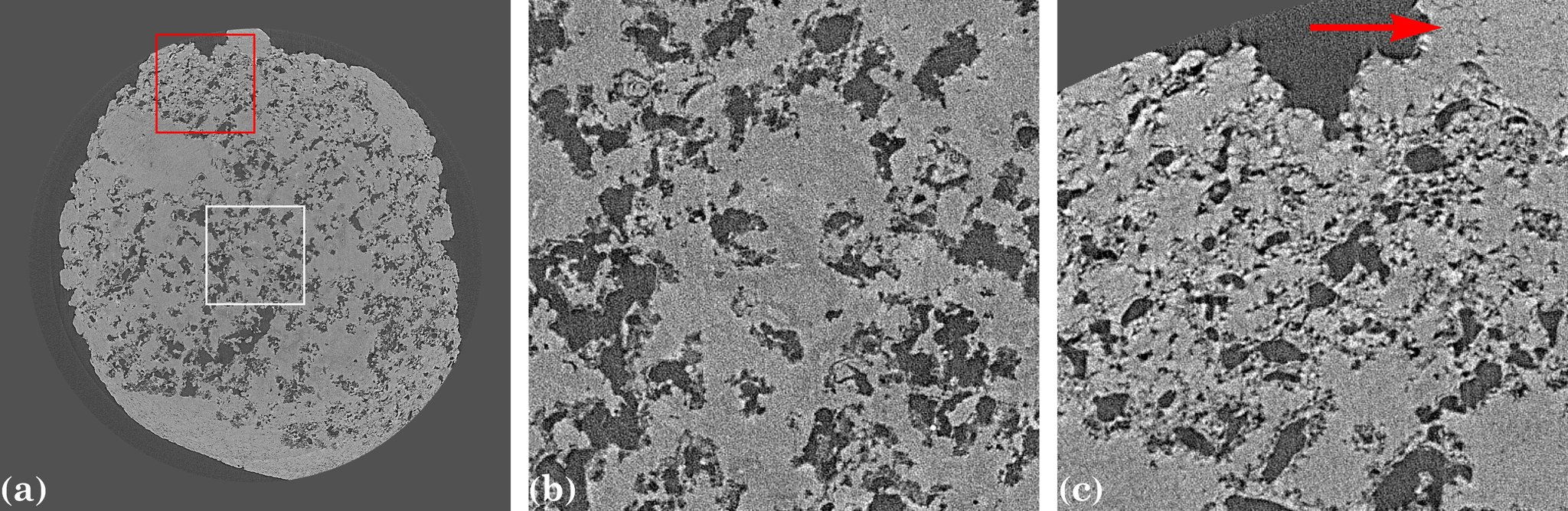
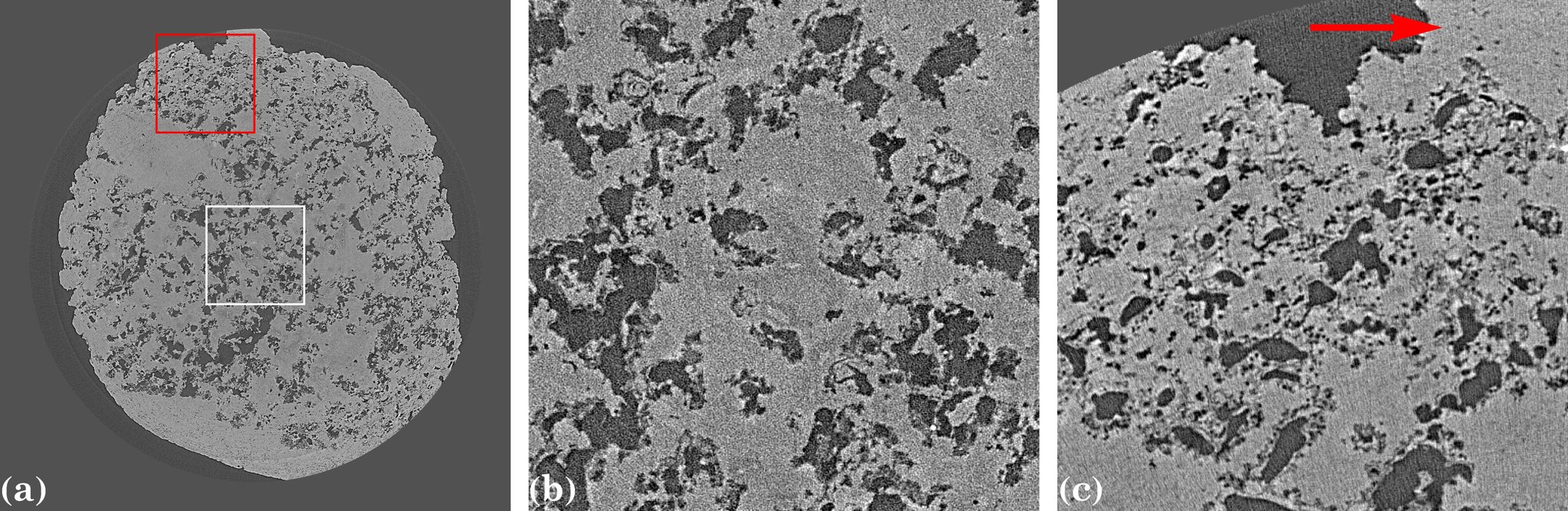
Distortion correction is important in tomographic applications which study small features such as pores or cracks as shown in Fig. 2 and Fig. 3.
To generate a single corrected sinogram, users need to provide a chunk of adjacent sinograms, i.e. by adjusting the “preview” parameter of a loader, as the distortion correction method uses neighbouring pixels for interpolation.
Distortion correction needs to be used in processing data from scanning techniques; which extend the FOV of a parallel-beam tomography system such as half-acquisition scans, grid scans, or helical scans; because the distortion problem significantly affects the quality of stitched images.